

Plenty of Southern California shops machine parts, build boards, or write code that ends up inside defense systems without ever holding a defense contract. The work comes through a prime. If you run a small supplier in Orange, Los Angeles, or San Diego County and you don’t know a single buyer at a prime yet, the useful question isn’t who to email. It’s why a prime would go looking for you at all. That’s the practical core of how to work with prime contractors, and it starts with a rule in the Federal Acquisition Regulation (FAR).
Why Primes Go Looking for Small Suppliers
A small business subcontracting plan is the document a prime contractor that isn’t itself small submits to show how it will use small businesses on a federal contract. It sets separate percentage goals for small, veteran-owned, service-disabled veteran-owned, HUBZone, small disadvantaged, and women-owned businesses, and it names the person who runs the prime’s subcontracting program.
When does a prime need one? FAR 19.702 says a solicitation that’s expected to exceed $900,000 ($2 million for construction) and has subcontracting possibilities requires the apparently successful offeror to submit an acceptable plan. No plan, no award. Small businesses are exempt. You won’t write one. Your future customer will.
$900,000: the expected contract value above which a solicitation with subcontracting possibilities requires a small business subcontracting plan ($2 million for construction). Source: FAR 19.702, Statutory requirements (FAC 2026-01, 2026)
Here’s the line most subcontracting guides skip. FAR 19.704(a)(5) says the plan must include “a description of the method used to identify potential sources for solicitation purposes.” So every prime holding one of these plans has put in writing, in a document the contracting officer has to accept, how it finds small suppliers. That’s your opening. Learn the method. Then get inside it.
One side road. FAR 19.702(d) lets a mentor firm in the DoD Mentor-Protégé Program credit certain developmental assistance costs toward its subcontracting goals, once the Director, Small Business Programs of the cognizant military department or defense agency approves the agreement. Slower. Narrower, too. Ask that office who qualifies right now.

Where a Prime’s Small Business Office Looks for Subs
Here’s the prime’s side of it, as SBA’s prime and subcontracting guide tells it: when a buyer needs a small sub, one stop is the Small Business Search (SBS, the tool SBA used to call the Dynamic Small Business Search), and what comes back is whatever small firms typed into their own profiles.
So type well. SBA lists the fields it wants filled: socioeconomic representations and certifications, a capabilities narrative, keywords, NAICS codes, performance history. Leave one blank and you’ve made the search harder for the one person trying to find you.
Keywords are where shops lose. “Precision manufacturing solutions” describes half the units in any business park. “5-axis titanium, AS9100, anodize in-house” describes one.
Where a buyer can find you, and what’s yours to fix:
| Where | Who runs it | What you control |
|---|---|---|
| Small Business Search (SBS) | SBA | Your profile: NAICS codes, keywords, capabilities, certifications |
| SUBNet | SBA; large businesses post notices | Searching posted opportunities |
| A prime’s supplier portal | The prime | Your registration and the documents it asks for |
| Industry days and matchmaking events | Event hosts, the cluster included | Showing up prepared |
Then the list that tells you who to court. SBA links agency directories of large primes and its own Directory of Federal Government Prime Contractors with a Subcontracting Plan, which is about as close as you’ll get to a roster of buyers who have set small business goals on paper and now have to show progress against them. SUBNet is worth a look on the day you search. It changes.
The Defense Subcontracting Checks That Flow Down to You
Fair warning: this part is about contract clauses, and it’s dry. It’s also the part that can stop an award. When a defense subcontract will involve covered defense information (a kind of controlled unclassified information, or CUI), the prime has to put DFARS 252.204-7012 into your subcontract without alteration, except to identify the parties, and that clause makes your covered information systems subject to the security requirements in NIST SP 800-171. Then comes DFARS 252.204-7020, whose paragraph (g)(2) says the prime shall not award a subcontract that’s subject to those NIST SP 800-171 requirements unless the subcontractor has completed, within the last three years, at least a Basic NIST SP 800-171 DoD Assessment for the relevant systems.
Read that again. Not a certificate. Not a perfect score. A completed Basic Assessment, inside three years. Paragraph (g)(3) adds that a subcontractor without a current score posted in the Supplier Performance Risk System (SPRS) may conduct and submit a Basic Assessment itself.
Here’s the rule we’d use. If the parts, drawings, or data you’d handle for a prime count as covered defense information, finish the Basic Assessment before you register on that prime’s supplier portal, not after a buyer asks for it. If they don’t, the clause isn’t your problem yet. Our CMMC and compliance readiness service covers readiness guidance and gap assessments, and it refers members to qualified assessors when they need one.
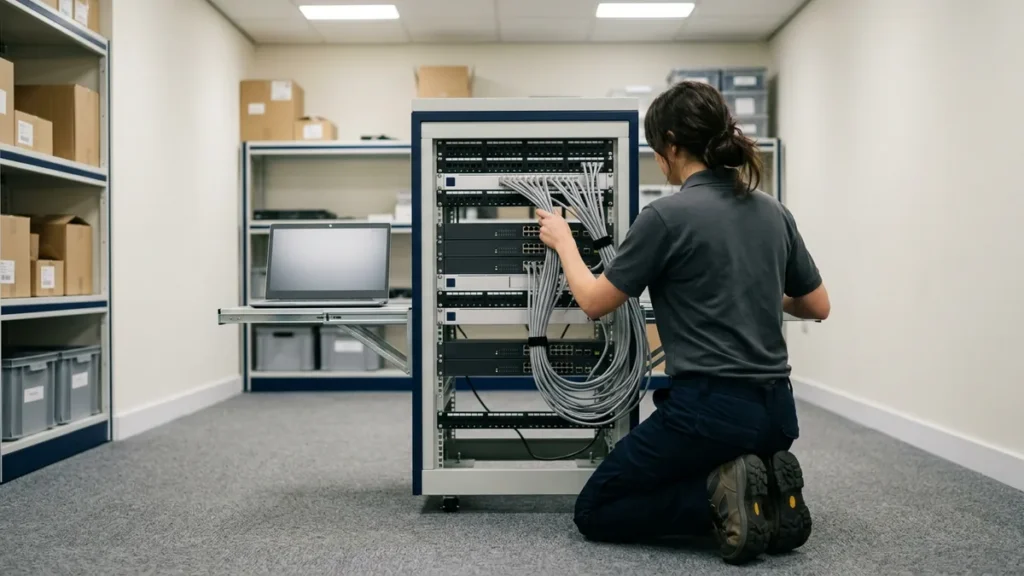
How to Work With Prime Contractors When You Have No Contacts
No names yet? Fine. This is the order we’d take it in.
- Write down your NAICS codes and one sentence on what you do better than the shop down the street. Everything after this reuses it.
- The SBS profile, every field SBA lists, in a buyer’s words.
- Open SBA’s Directory of Federal Government Prime Contractors with a Subcontracting Plan and shortlist three to five primes that buy in your NAICS codes.
- Will the work touch covered defense information? Then the Basic NIST SP 800-171 DoD Assessment comes now, not later.
- Register on each shortlisted prime’s supplier portal, and find out who runs its small business office.
- Go where their buyers go. The cluster’s events page lists industry days and matchmaking sessions as they’re scheduled.
- Follow up within a week, with a capability statement cut down to that one prime’s needs.
Short list. Long afternoons. Step three is the easy one to skip, and skipping it means guessing which primes to court.
What Southern California Changes
Distance, mostly. San Diego County alone has NIWC Pacific, Naval Base San Diego, Camp Pendleton, and MCAS Miramar; Los Angeles County is home to major defense prime operations along the LA to Long Beach corridor; and Orange County is a hub for aerospace and defense technology companies, engineering firms, and component suppliers. A short drive means you can make a prime’s supplier day and answer a quality question in person.
The cluster’s Prime Contractor Matchmaking service facilitates introductions and runs a supplier readiness review first. In the service page’s own words: “We don’t guarantee placement with a prime contractor.” We’d rather you hear that here.
You may not need us at all. SBA’s guide suggests contacting an APEX Accelerator (formerly a Procurement Technical Assistance Center) for help finding subcontracting opportunities. For the basics of what primes weigh in a new sub, read our earlier guide to subcontracting with primes.
Questions Suppliers Ask Before Calling a Prime
So what is a subcontracting plan, and why should a small supplier care?
A subcontracting plan is a prime’s written set of goals for using small businesses on a federal contract over FAR 19.702’s threshold. It also has to describe how the prime finds small sources. That’s the door.
How do primes actually find small subcontractors?
Short answer: mostly by searching. SBA says primes use its Small Business Search to find small businesses, and that large businesses can post subcontracting notices to SBA’s SUBNet database. Primes also run their own supplier portals and send buyers to industry days. Referrals count too.
Does a small supplier need a NIST SP 800-171 assessment before a prime will award a subcontract?
Only when the subcontract carries the NIST SP 800-171 requirements under DFARS 252.204-7012. Then DFARS 252.204-7020(g)(2) bars the award unless you’ve completed at least a Basic Assessment within the last three years. Work that involves no covered defense information and no operationally critical support doesn’t carry 7012 at all.
A supplier portal or an SBS profile: which one does a prime actually read?
Wrong question, slightly. You need both, because they do different jobs.
The SBS profile is how a prime’s small business office finds you when it searches by NAICS code or keyword. The portal is how one specific prime onboards you once it’s interested, with its own forms. Do the SBS profile first. It’s the one SBA says primes use.
What does the cluster do, and not do, in prime matchmaking?
No placement promises. The service page puts it bluntly: “We don’t guarantee placement with a prime contractor.” What the cluster does is set up introductions, get eligible members ready for them, and point out subcontracting openings that look worth the effort. Your capabilities and readiness matter. So does whatever the prime happens to need that quarter.
Does a mentor-protégé agreement help a small supplier?
15 U.S.C. 637(d)(12). FAR 19.702(d) leans on that law to let a mentor in the DoD Mentor-Protégé Program count some of its developmental assistance spending toward its subcontracting goals. In plain terms, the mentor gets credit for helping you grow. There’s a catch, or two. The Director, Small Business Programs at the relevant military department or defense agency has to approve the agreement before any of it counts, and the program sets its own eligibility rules, which you’d confirm with that office directly.
Where else can a supplier get help finding subcontracting opportunities?
Try an APEX Accelerator. SBA’s own guide sends small businesses there when they want help finding subcontracting work. If your shop sits outside Orange, Los Angeles, and San Diego Counties, write to the cluster anyway. We’ll point you somewhere useful.
Get Ready Before the Introduction
Better to fix a capability statement before a buyer reads it than after. That’s the point of the cluster’s supplier readiness review, for eligible small businesses in Orange, Los Angeles, and San Diego Counties. Membership and cluster-funded services are provided at no cost to eligible participating businesses, subject to program requirements and available resources.